My First 14 Days with Oura
A longitudinal UX study of the journey from onboarding to everyday use
I started this study with very little prior knowledge of Oura and no previous experience with wearables, activity trackers or smartwatches. Rather than learning about the product beforehand, I wanted to see how the experience itself would teach me what Oura does, how to use it and what value it could offer.
Over 14 days, I documented my experience from initial setup and onboarding through the first days of personal data and towards more independent, everyday use. I paid attention not only to usability, but also to how my understanding of the product developed, what I discovered or struggled to understand, how I interpreted and learned to trust the data, and whether continuous tracking began to influence my behaviour. I returned to the experience two weeks later to see what remained once the novelty, and the research itself, had faded.
This was a self-initiated, first-person study based entirely on my own experience and observations. I used a pre-owned Oura Ring Gen3 purchased second-hand, so the physical unboxing and setup may differ from buying a new ring, and the current Oura experience may have changed since Gen3.Mapping the first-use journey
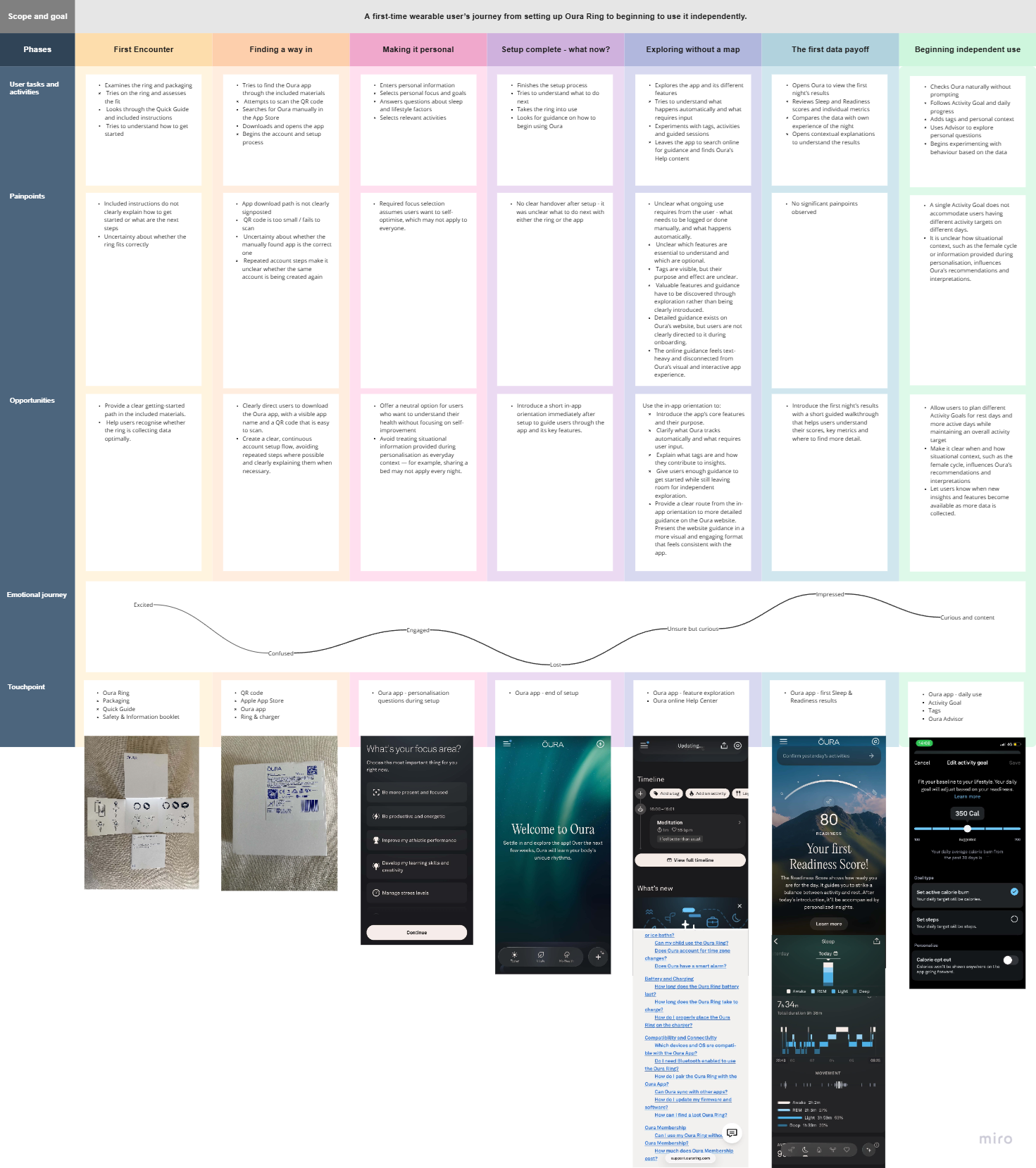
I mapped my experience during the first few days with Oura, from setting up the ring and exploring the app to receiving my first data and beginning to use the product independently.
A strong first impression
My first impression of the physical product was very positive. The ring, packaging and visual instructions all felt considered, and the Quick Guide made it immediately clear how the ring should be worn. The first uncertainty appeared when it was time to move from the physical product to the digital experience. It wasn't obvious which app I needed to download, and when the small QR code found on the package didn't work and there were no other instructions, I searched for Oura in the App Store and downloaded what turned out to be the correct app.
A few bumps in the setup
Once inside the app, the technical setup was mostly straightforward, although parts of the account and pairing process felt repetitive. At one point I was asked for my email again and seemed to return to the beginning of the process, which made me wonder whether I had already created an account or was starting over. Pairing also took several attempts, partly because I was using a pre-owned ring that needed to be reset. When I did need troubleshooting, however, the instructions were clear and easy to follow.
Personalisation made it feel personal
The experience became much more engaging during personalisation. Questions about my goals, sleep and usual activities made it feel as though Oura was beginning to understand what might be relevant to me. I particularly liked how broad some of the activity options were, and the visual design made this part of the setup feel enjoyable rather than administrative. Towards the end, Oura also explained that more insights would become available as it learned from my data over the following days, which gave me something to look forward to.
One question did stand out, however: users were required to choose a personal focus, such as being more productive and energetic, improving athletic performance or managing stress levels. This seemed to assume that there was something they wanted to achieve or improve. It made me think, that there could also be room for users who are simply curious about their body and their data, without necessarily wanting to optimise anything.Setup complete - what now?
The biggest gap appeared once the setup was complete. The ring was still on the charger as instructed, and I wasn't explicitly told that it was now time to put it on and simply start wearing it. At the same time, the app was open and ready to use, but I had no clear sense of where to start, what I was supposed to do or even what I should be looking at.
More importantly, I didn't yet understand what everyday use was supposed to look like. What would Oura track automatically? What did I need to add myself? As a first-time wearable user, I also wasn't sure how important it was to keep the ring on continuously. If I took it off for a while, how much would that matter? And when was I supposed to charge it if ideally it should be on my finger collecting data? I could work many of these things out by exploring, but there was no clear handover from setting up the product to actually living with it.
Exploring without a map
Exploring the app itself was enjoyable. It was visually engaging, there was clearly much more to the product than I had expected, and I kept discovering features that made me more interested in what Oura could do. At the same time, some features were visible without their purpose being immediately clear. Tags and activities were good examples: I could see that I could add them, but didn't yet understand when or why I should. Other features, such as guided meditation sessions, were exciting discoveries that I simply happened to come across while exploring.
There were still many unanswered questions, so I eventually went online to look for more information and found Oura's online guide. It contained extensive guidance on getting started and using the product, including answers to many of the questions I had been trying to work out on my own. However, it was very text-heavy, and compared with the visual and engaging experience of the app, I didn't really feel like spending much time there.My data changed the experience
The experience changed significantly the next morning, when my first real set of personal data appeared. I had expected fairly basic information from a single night, but was genuinely impressed by how much Oura had already captured. Alongside sleep duration and heart rate, I could see sleep stages, REM sleep, sleep efficiency, movement, blood oxygen, breathing regularity and more. I could even recognise in the visualisation the period when I knew I had been awake during the night.
It was also a striking contrast to the uncertainty I had felt after setup. This time, I immediately understood what I was looking at and where to direct my attention. Individual metrics were clearly explained, and I could go deeper when I wanted to understand how something had been measured or interpreted. Once there was real personal data to respond to, learning how to use Oura became much more intuitive. Over the following days, I gradually needed less guidance. I learned what to look at, developed my own ways of using the app and started opening it with a purpose rather than simply exploring what was there.Oura was better at teaching me my data than teaching me the product.
Insights from the first 14 days
01 — Tracking became normal surprisingly quickly
Before using Oura, I hadn't really thought about how it would feel to have something continuously measuring me. Once I put the ring on, I became surprisingly aware of it. I caught myself thinking about whether everyday things (even getting excited while cooking) might affect my heart rate and show up in the data. It raised an interesting question early on: was I using the data to better understand myself, or would I start changing my behaviour to make the data look good?
That feeling faded much faster than I expected. Within a few days, I barely thought about being monitored anymore, even though the tracking itself hadn't changed. By Day 3, I estimated that only around 3% of that initial feeling of being monitored remained, and by Day 6 it was essentially gone. What did change was how the tracking affected my behaviour. At first, being measured made me slightly self-conscious and aware of what the ring might record. On Day 1, for example, seeing my Activity Goal at 99% made me do a little more exercise simply to reach 100%.Later, the same tracking started working almost in the opposite way. By Day 7, knowing that my activity would be recorded made movement feel more motivating and rewarding. I described it as a kind of positive accountability rather than score chasing. Oura was influencing my behaviour, but I didn't feel that I was arranging my life around producing better numbers. By Day 14, continuous tracking had simply become normal. I still knew the ring was measuring me, but I barely thought about it.
The tracking stayed the same, but its role changed from something I was conscious of to something that quietly supported my behaviour in the background.
02 — Data was most useful when it helped explain how I felt
The data felt most valuable when it helped me make sense of something I was already experiencing. On my first morning, for example, I felt as though I had slept badly. Oura showed a good overall night but poor restfulness, giving me a more nuanced explanation for why I still felt that way.
The experience became more complicated when Oura's interpretation and my own experience didn't align. On Day 10, my Readiness Score was 82 even though I felt exhausted. The underlying data and a conversation with Advisor eventually provided context that made my tiredness understandable, but that context wasn't obvious from the headline score itself.Over time, this changed how I thought about trust in the product. The question became less about whether Oura was “right” and more about whether I could understand how it had reached its interpretation and how that interpretation fitted with what my body was telling me. When the data helped me understand what might be behind how I was feeling, it also made the information more actionable: I could start to see what I might be able to change, rather than simply knowing if I felt tired or poorly recovered.
03 — Personalisation didn't always connect the context Oura already had
One of the biggest gaps I noticed was how separate cycle tracking felt from the rest of the Oura experience. For users who have a menstrual cycle, it isn't something that is only relevant within a dedicated cycle-tracking feature. It is part of the context in which their body is functioning throughout the month, with different phases affecting their needs, energy, recovery and how their body responds to things like sleep, stress and activity.
If Oura aims to interpret what is happening in the body, that context should therefore be reflected across the experience wherever it is relevant. Yet I found examples where it wasn't. For example, the Advisor on the app told me that cycle phase isn't taken into account when calculating Sleep Need, and in a conversation about body temperature, cycle context only entered the explanation after I brought it up myself, even though Oura itself recognised that cycle phase can have a significant effect on body temperature.This made cycle tracking feel more separate from the rest of the experience than I expected. Oura had access to relevant cycle information, but that information didn't always appear to carry through into the way other data was interpreted or explained.
04 — The product's value shouldn't depend on what users happen to discover
Some of Oura's most useful features weren't necessarily the easiest to discover. Advisor was one of the clearest examples. I came across it almost by chance while exploring the app, and it wasn't immediately clear what it was or why I might want to use it. I decided to give it a try as part of the research, and once I did, it quickly became one of the most valuable parts of the experience.
This made me think about exploration versus leaving discovery to chance. Exploring the app was enjoyable and often led to interesting things, but important features shouldn't depend on a new user happening to find them. The more central something is to understanding or getting value from the product, the more intentionally it should be introduced.05 — The underlying data became more valuable than the scores
At first, Oura's daily scores (such as Sleep, Readiness and Activity) naturally drew a lot of my attention. Over time, however, I became less interested in whether I got a high score or reached a goal and more interested in the information behind it. The individual measurements, patterns and changes over time gave me more to work with than a single number telling me how I was doing.
Activity was a good example. You can set a baseline Activity Goal, which Oura then adjusts slightly up or down for individual days based on your data and how ready it thinks you are for activity that day. But that doesn't necessarily reflect the kind of day you are actually planning to have. My routine alternates between more active days and rest days on purpose, so the amount of activity I intend to do each day varies significantly. Because of this, reaching Oura's Activity Goal mattered relatively little to me. What mattered more was the activity data itself: how much activity I had accumulated and whether it matched what I had intended for that particular day.By the end of the study, I found myself looking beyond the overall scores more generally. A single score combines several different signals, but the information underneath it showed me where something might actually be off and gave me a better idea of what I could respond to or change. I valued Oura less as something that told me how well I was doing, and more as a source of information that helped me understand my own patterns, interpret what was happening and decide whether there was something I wanted to act on.
Early use: “Is my score good?” → Later use: “What does the data tell me?”
Recommendations
01 — Create a lightweight orientation layer after setup
A short, skippable orientation after setup could establish a simple mental model of everyday use: what Oura tracks automatically, what the user may want to add themselves, and how features such as activities and tags fit into the experience. It could also briefly guide the user through the app itself, showing where the main areas and features are located, what they are for, and where different types of data and insights will begin to appear.
The aim wouldn't be to teach every feature upfront, but to give users enough context to start using and navigating the product confidently. More detailed explanations could then be introduced contextually as they become relevant, which is something Oura already did relatively well once my own data started appearing. The orientation could also point users towards Oura's online guide, which I only discovered later by actively looking for more guidance myself.02 — Let activity goals reflect different types of days
Activity goals could allow users to account for days that are intentionally different from one another. Rather than relying mainly on one baseline goal that is adjusted based on Oura's assessment of the user's readiness, users could indicate that a particular day is, for example, a rest day, gym day or otherwise more or less active day.
This would allow the goal to reflect not only what the data suggests the user is capable of that day, but also what they actually intend to do. For users whose routines naturally vary throughout the week, this could make the daily goal feel more personally relevant and meaningful.03 — Treat cycle data as part of the overall picture
For users who have a menstrual cycle, cycle data should be treated as part of the overall picture and used across the app wherever it is relevant. Rather than primarily existing within cycle-specific features, it could inform relevant scores, insights and recommendations alongside the other data Oura collects. This also raises questions about metrics that are presented as relatively stable, such as Sleep Need or daily activity expectations. Do these needs and capabilities remain the same throughout the cycle, or could cycle data help Oura recognise when they may change? A personalised baseline may not necessarily be a fixed baseline for someone whose body follows a monthly cycle.
One aspect of Oura's approach made me question how this data is currently used. Oura explains that changes during the luteal phase can resemble signs of strain and that its cycle-aware algorithm reduces the negative impact these changes can have on the Readiness Score. While I understand the intention, I think the assumption that these changes should have less impact on Readiness is worth questioning.Rather than adjusting the score upwards because signs of strain can be explained by the menstrual cycle, another approach could be to treat both the cycle phase and those signals as meaningful information about how ready the user may be that day. PMS is commonly associated with experiences such as tiredness and lower energy, so a lower sense of readiness during this phase isn't necessarily something the product needs to correct for. For people with a menstrual cycle, these fluctuations are part of the body's natural monthly rhythm. Readiness may genuinely change across that rhythm, and allowing the score to reflect those changes could make it more representative of the user's lived experience rather than trying to smooth them out.
The goal wouldn't be to assume that everyone experiences their cycle in the same way, but to use cycle data as another input in building a more individual picture. Instead of making cycle-related changes less visible in Readiness, Oura could use them to help the score and its explanation better reflect the user's actual experience.04 — Make online guidance feel more like Oura
Oura's app feels visual, interactive and polished, but the online help content felt surprisingly different. The information was extensive, but very text-heavy and less engaging to explore.
Bringing more of the visual and interactive quality of the app into these resources could make learning about Oura feel like a more natural continuation of the product itself, rather than stepping away from it to read documentation.Two weeks later
Two weeks after the diary study ended, I returned to the experience to see what had remained once the novelty and the extra attention created by the research had faded.
What stood out most wasn't simply that I was still using Oura, but that some of the ways I thought about my own data had changed. Sleep was a particularly clear example. Before using Oura, I tended to judge how well I had slept largely by how I feel when I wake up. Over time, the data helped me see that morning tiredness didn't always tell the whole story. Sometimes the feeling was supported by other signs of poor recovery, while other times the wider picture suggested that I had actually recovered well. The data didn't replace how I felt, but gave me another perspective on what that feeling might mean, or not mean, for the coming day. This has changed how I approach my days: rather than letting morning tiredness set my expectations for the day ahead, I can better judge whether I genuinely need to take it easy or whether I may be capable of more than I initially feel. Some behavioural effects had remained too. Tracking activity still made movement more motivating and fun, and I had continued some of the recovery and meditation behaviours I first tried during the study. More broadly, Oura had settled into a useful role in my everyday life. I didn't expect the data to tell me exactly how I felt or what I should do, but used it as another source of information alongside my own experience. I also came to appreciate the fact that the ring has no screen and requires very little attention on its own. Because there is nothing to check on the ring itself, it can easily fade into the background and simply collect data while I go about my day. It was also so comfortable to wear that I could keep it on all the time without really thinking about it. I noticed the contrast clearly when I wore a smartwatch for one night for comparison and found it very uncomfortable almost immediately.Beyond the findings of the study, I also simply really enjoyed using Oura. The more I used it, the more interesting the product became to me — not only because of the data itself, but because of the many different ways it can help make sense of it. What started as a two-week study has become something I genuinely want to keep using in my everyday life. I'm already planning to upgrade from the second-hand Gen3 ring I used for this study, and I'm curious to see how the experience continues to develop as Oura learns more about me over time.
Two weeks later, the description I gave Oura at the end of the study still felt surprisingly accurate: “a good companion.”
© 2025 Created by Salla Lampinen